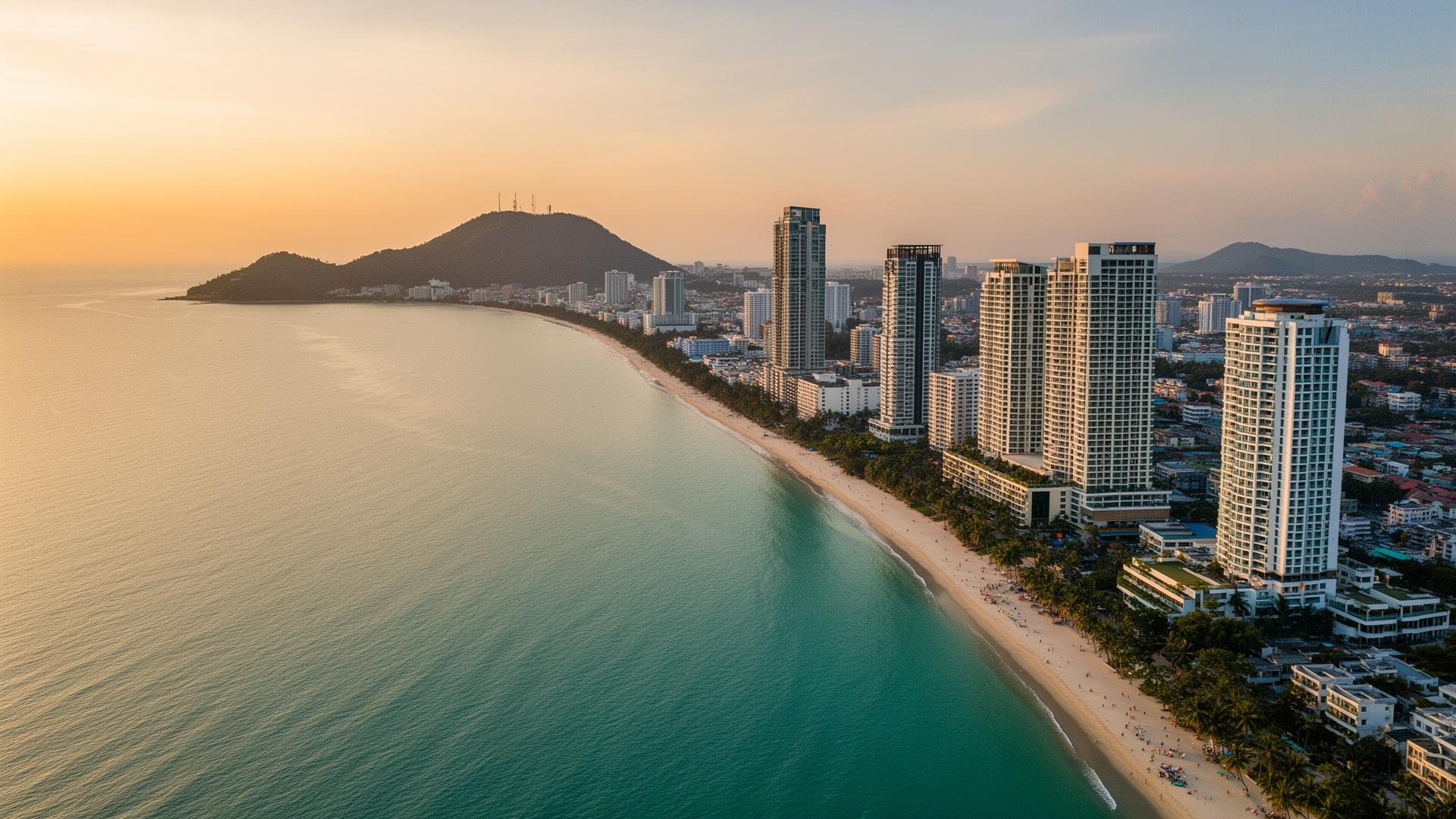

Pattaya · Open Access Guide
Pattaya Investor
Guide.
An institutional primer for international investors entering the Pattaya property market. Free, open access, no registration required.
Before We Begin
If Pattaya is on your shortlist, read this first.
This guide is for international investors who have decided to look at Pattaya seriously and need to understand how the market actually works. It does not assume prior knowledge of Thai ownership law, the Eastern Economic Corridor, Walking Street's reputation, or the difference between Wongamat and Jomtien. By the end of it you will know whether Pattaya fits your mandate, which of its ten submarkets matches your objective, and what to research next.
Two principles run through everything below. Pattaya is ten submarkets, not one. Treating it as a single market is the single most expensive mistake foreign investors make here. EEC is fact; casino is speculation. Our underwriting weights both accordingly, and so should yours.
It is an open-access institutional primer. No registration, no gating. Read it once and you will evaluate Pattaya at the same level of seriousness as buyers paying institutional broker fees for the same information.
The Story
Two condominiums, two kilometres apart, two different investments.
Imagine two condominiums in Pattaya, both at roughly the same price per square metre. One sits on the Wongamat beachfront, quiet, prime, anchored by branded residences and a high-net-worth tenant base. The other sits two kilometres south in the tourism core of Central Pattaya, surrounded by Beach Road, Walking Street and Central Festival.
Both are good investments. Neither is a good investment for the same buyer. Wongamat is a long-hold capital-preservation asset. Central Pattaya is a tourism-yield asset that demands operational discipline. The submarket decides the investment, not the building.
This guide is built to make sure you choose the right one for what you are trying to achieve.
The Simple Answer
Pattaya in 300 words.
Pattaya is the second-deepest investable property market in Thailand and the most accessible coastal market for foreign-freehold condominium product. It is ten distinct submarkets organised into three tiers: prime beachfront (Wongamat, Pratumnak, Jomtien), functional and hybrid (Central Pattaya, Naklua, Na Jomtien, Bang Saray) and inland and villa (East Pattaya, Huay Yai, Sattahip).
Four structural drivers underwrite the city's thesis: Bangkok proximity via Motorway 7, anchor positioning inside the Eastern Economic Corridor, top-three Thai destination status for international arrivals, and the lowest foreign-accessible entry tickets of any Thai resort cluster, starting around USD 100k-150k in mid-market submarkets.
Foreign ownership is well-defined. Freehold inside the 49% condominium foreign quota is the cleanest route; long-term leasehold covers villas. The Entertainment Complex licensing process is real, but no licence has been awarded, no Pattaya site has been confirmed and no ranking on this page assumes one will be. Promotional claims of "doubled arrivals" are speculation and do not appear in our underwriting.
The investors who do well in Pattaya match the submarket to the mandate, underwrite net rather than gross, and treat the EEC as a long-cycle tailwind rather than a near-term catalyst. The rest of this guide is the evidence.
Why This Guide Matters
Pattaya is the most segmented Thai market, and the most misjudged.
The dispersion between Pattaya's best and worst submarkets is wider than in any other Thai market we cover. Wongamat trades at a structural premium to East Pattaya. Bang Saray prices have outrun Jomtien on a five-year basis. Central Pattaya delivers yields that prime Wongamat cannot, and Wongamat delivers resale depth that Central Pattaya cannot.
This guide gives you the comparative frame to navigate that dispersion before you fall in love with a specific project. Use it as the structural foundation, then descend into the Pattaya Submarket Intelligence Centre for the rankings and per-submarket research.
How To Use This Guide
Read it in this order.
Step 1. Read the Executive Summary and the four structural drivers below to anchor the thesis.
Step 2. Work through Major Investment Areas to understand the ten-submarket geography.
Step 3. Read Ownership Structures so you know which legal route fits which asset type.
Step 4. Read the EEC and Entertainment Complex section carefully; this is where most marketing claims fall apart.
Step 5. Use the Rental Market and Capital Growth Drivers sections to underwrite specific opportunities, and the Key Risks list to stress-test them.
Step 6. Cross-reference with the Pattaya Intelligence Centre for the rankings layer.
What You Will Learn
By the end of this guide you will know.
Why Pattaya is investable as a standalone market. Which of its ten submarkets fit which investor mandate. How foreign ownership works for each asset type, and which structures to avoid. How the Eastern Economic Corridor affects long-let demand and which submarkets are directly exposed. How to separate Entertainment Complex marketing claims from underwriting reality. What realistic net rental economics look like across short-let, long-let foreign tenant and EEC professional segments. The risks that materially change a Pattaya thesis, and how to mitigate them. Where Pattaya plausibly sits in 2035, under base, acceleration and risk scenarios.
Executive Summary
What this guide concludes in one page.
Pattaya is the second-deepest investable property market in Thailand and the most accessible coastal market for foreign-freehold condominium product. It is not a single market. It is ten distinct submarkets anchored by Bangkok proximity, EEC industrial activity, multi-source-market tourism and the lowest foreign-accessible entry tickets of any Thai resort cluster. This guide covers the structural primer; comparative rankings live in the Pattaya Intelligence Centre.
Why Pattaya
The four structural factors that underwrite the thesis.
- Bangkok proximity~140 km from Bangkok via Motorway 7; the only Thai resort market with weekend-commuter demand from Bangkok HNW households (FACT). Underwrites Wongamat and Pratumnak pricing.
- EEC anchorPattaya sits inside the Eastern Economic Corridor (EECO, FACT). EEC industrial activity supports professional and family long-let demand in East Pattaya, Huay Yai, Sattahip, Bang Saray and the EEC perimeter.
- Tourism depthTop-three Thai destination by international arrivals (TAT, FACT). Multi-source-market diversity (China, India, Russia, ASEAN, Europe) reduces single-market concentration risk.
- Accessibility of entryThe lowest foreign-accessible entry tickets of any Thai resort cluster. Investable foreign-freehold condominium product begins around USD 100k–150k in mid-market submarkets.
Major Investment Areas
Ten submarkets, three tiers.
The Pattaya investment universe spans ten submarkets that cluster into three institutional tiers:
- Prime beachfront tier: Wongamat, Pratumnak, Jomtien. Deepest beachfront freehold stock, strongest pricing power, lowest reputational drag.
- Functional / hybrid tier: Central Pattaya, Naklua, Na Jomtien, Bang Saray. Yield, residential fundamentals, and infrastructure-thesis optionality.
- Inland / villa tier: East Pattaya, Huay Yai, Sattahip. Family long-let, golf-community lifestyle, EEC-thesis exposure.
Detailed rankings and per-location intelligence briefs are published in the Pattaya Intelligence Centre.
Ownership Structures
The four ownership routes available to foreign investors.
- Foreign-freehold condominiumThe cleanest route. Up to 49% of a condominium's total unit area may be held in foreign freehold. Title is registered at the Land Office in the investor's name.
- Thai-quota condominium with leaseholdWhere the foreign quota is full, units in the Thai quota may be acquired on long-term leasehold. Lease structures and renewability vary; legal review is non-optional.
- Villa leaseholdVillas (East Pattaya, Huay Yai, Bang Saray) cannot be held in foreign freehold. Standard structure is a long-term registered lease, sometimes layered with renewal options. Counterparty quality and lease structure determine the security of the position.
- Company structuresHistorically used to hold villa land. Subject to scrutiny if used purely as a proxy for foreign ownership; structures must demonstrate genuine commercial purpose. Independent legal advice required.
Educational summary only. See the Foreign Ownership Framework for the full treatment. Not legal advice.
EEC & Entertainment Complex
The two scenarios every Pattaya investor must understand.
- EECPattaya, Sattahip and U-Tapao sit inside the Eastern Economic Corridor (FACT). Direct property exposure flows to East Pattaya, Huay Yai, Sattahip, Bang Saray and Na Jomtien via industrial and professional long-let demand. U-Tapao Phase 2 and HSR are SCENARIO, not basecase.
- Entertainment ComplexNo Entertainment Complex licence has been awarded in Thailand. No site has been confirmed for Pattaya. No ranking in our research assumes casino approval, casino construction or casino opening. Promotional claims of doubled arrivals are SPECULATION and excluded from underwriting.
Full evidence-mode treatment lives in the Entertainment Complex Analysis section of the Intelligence Centre.
Rental Market
What the rental economics actually look like.
Pattaya rental income falls into three distinct economics:
- Short-let / tourism (Central Pattaya, Jomtien): highest gross yields city-wide; net economics eroded by competition, platform fees and Hotel Act enforcement risk on sub-30-day stays.
- Long-let foreign tenant (Jomtien, Pratumnak, Wongamat, Naklua): 30+ day tenants, deeper pool than west-coast Phuket equivalents, stable occupancy.
- EEC professional long-let (East Pattaya, Huay Yai, Bang Saray): family-segment tenants from EEC industrial and managerial roles; modest yields, stable occupancy.
Headline gross yields advertised by developers are not directly comparable to the net economics above. Underwrite net of operator fees, sinking fund, common-area charges and realistic vacancy.
Capital Growth Drivers
What actually drives Pattaya capital values.
- Bangkok proximityWeekend-commuter demand from Bangkok is the single most under-priced structural driver of Wongamat and Pratumnak pricing.
- Beachfront scarcityTrue beachfront freehold land in Wongamat, Pratumnak and Na Jomtien is finite. Constrained supply is the strongest cluster-wide growth driver.
- EEC industrial activitySustained EEC investment supports long-let demand and resale-pool depth in directly-exposed submarkets. EEC is FACT; HSR / U-Tapao Phase 2 acceleration is SCENARIO.
- Source-market diversificationPost-2022 rebalancing of the foreign-buyer mix (Russian / CIS, Chinese, Indian, European, ASEAN) reduces concentration risk but exposes Pattaya to Russian / CIS demand reversal.
Key Risks
The risks investors should underwrite explicitly.
- Russian / CIS demand concentration is the single largest demand-side risk to mid-market rentals.
- Mid-market oversupply in Jomtien Second Road and inland Central Pattaya vintages.
- Reputational drag from Walking Street nightlife caps Central Pattaya capital growth.
- Short-let regulatory risk: Hotel Act enforcement on sub-30-day rentals varies by political cycle.
- Infrastructure slippage: HSR and U-Tapao Phase 2 timelines have historically slipped.
- Currency exposure: THB volatility can swing realised returns by 10–20% across a holding period.
- Foreign-ownership friction in the villa belt (East Pattaya, Huay Yai, Bang Saray).
- Climate & coastal risk: sea-level, storm-surge and flooding exposure.
Pattaya 2035 Snapshot
Where Pattaya plausibly sits in ten years.
The institutional 2035 outlook is scenario-based, not a single forecast. The summary view:
- Base Case (most likely): tourism normalises, EEC industrial activity sustains long-let demand, no casino licence awarded; capital growth tracks Thai inflation plus a modest scarcity premium in prime beachfront submarkets.
- EEC Acceleration Case: U-Tapao Phase 2 and HSR commission within the window; south-corridor pipeline absorbs faster.
- Entertainment Complex Case (uncertain): licence awarded with Pattaya as host city; localised uplift plausible. Doubling of arrivals is NOT supported by evidence.
- Compound Growth Case: EEC and Entertainment Complex drivers compound; possible but compounding execution risk.
- Risk Case: tourism shock plus Russian / CIS reversal plus supply delivery produces multi-year reset; prime branded inventory more defensive but not immune.
Full scenario underwriting lives in the Pattaya Intelligence Centre.
Run the numbers
Translate the guide into an underwriting model.
Use the Total Return Calculator to model scenarios with your own ticket size and assumptions.
Open the calculatorIllustrative scenarios using calculator default assumptions. Outcomes vary with market conditions, operator performance and investor inputs.
Private Consultation
Speak with the Pattaya advisory desk.
Request a confidential briefing on current Pattaya opportunities aligned with your objectives, ticket size and risk profile.
Request Private ConsultationSources & References
Where this research draws its data (7)
Sources & References
Where this research draws its data (7)
Core Investments cites only published institutional sources. Figures referenced on this page are drawn from, or cross-checked against, the institutions listed below. For our editorial standards and source-vetting process, see our research methodology.
- [1]
Tourism Authority of Thailand (TAT) / Ministry of Tourism & Sports
International Tourist Arrivals to Thailand · 2024
https://www.mots.go.th/ → - [2]
- [3]
Savills
Asia Pacific Investment Quarterly & Thailand Spotlight · 2024
https://www.savills.com/research/ → - [4]
JLL Hotels & Hospitality
Hotel Investment Outlook. Asia Pacific (Annual) · 2024
https://www.jll.com/en/insights/research → - [5]
Knight Frank
The Wealth Report (Branded Residences & Prime International Residential Index) · 2024
https://www.knightfrank.com/wealthreport → - [6]
Bank of Thailand
Monetary Policy Report · 2024
https://www.bot.or.th/en/our-roles/monetary-policy/MPC-publication.html → - [7]
Sources last reviewed 2026-06-15
Disclosures
Important information (6)
Disclosures
Important information (6)
General disclaimer
Core Investments provides investment education, market intelligence, research and transaction-support services. Information published on this website is general in nature and does not constitute financial, investment, legal, tax or accounting advice, or personal recommendations. Investors should seek independent professional advice appropriate to their individual circumstances before making any investment decision. Past performance is not indicative of future results.
Rental return disclaimer
Rental income examples, occupancy assumptions and yield illustrations are provided for educational purposes only. Actual rental performance may vary based on market conditions, occupancy levels, operator performance, seasonality, competition, economic conditions and other factors. Rental returns are not guaranteed unless expressly stated within a legally binding agreement.
Capital appreciation disclaimer
Capital appreciation examples and growth projections are illustrative only and should not be interpreted as predictions or guarantees of future performance. Property values may rise or fall and are influenced by market conditions, supply, demand, economic factors, regulatory changes and investor sentiment.
Currency disclaimer
Currency markets are inherently volatile. Exchange-rate movements can positively or negatively affect investment returns when converted into an investor's home currency. Currency examples are provided for educational purposes only and do not constitute forecasts.
Legal ownership disclaimer
Property ownership structures, regulations and legal frameworks may change over time. Investors should obtain independent legal advice regarding ownership structures, taxation, residency implications and regulatory compliance before proceeding with any transaction.
Forecast disclaimer
Forecasts, projections and forward-looking statements are based on information available at the time of publication and involve assumptions that may not materialise. Future events may differ significantly from projected outcomes.