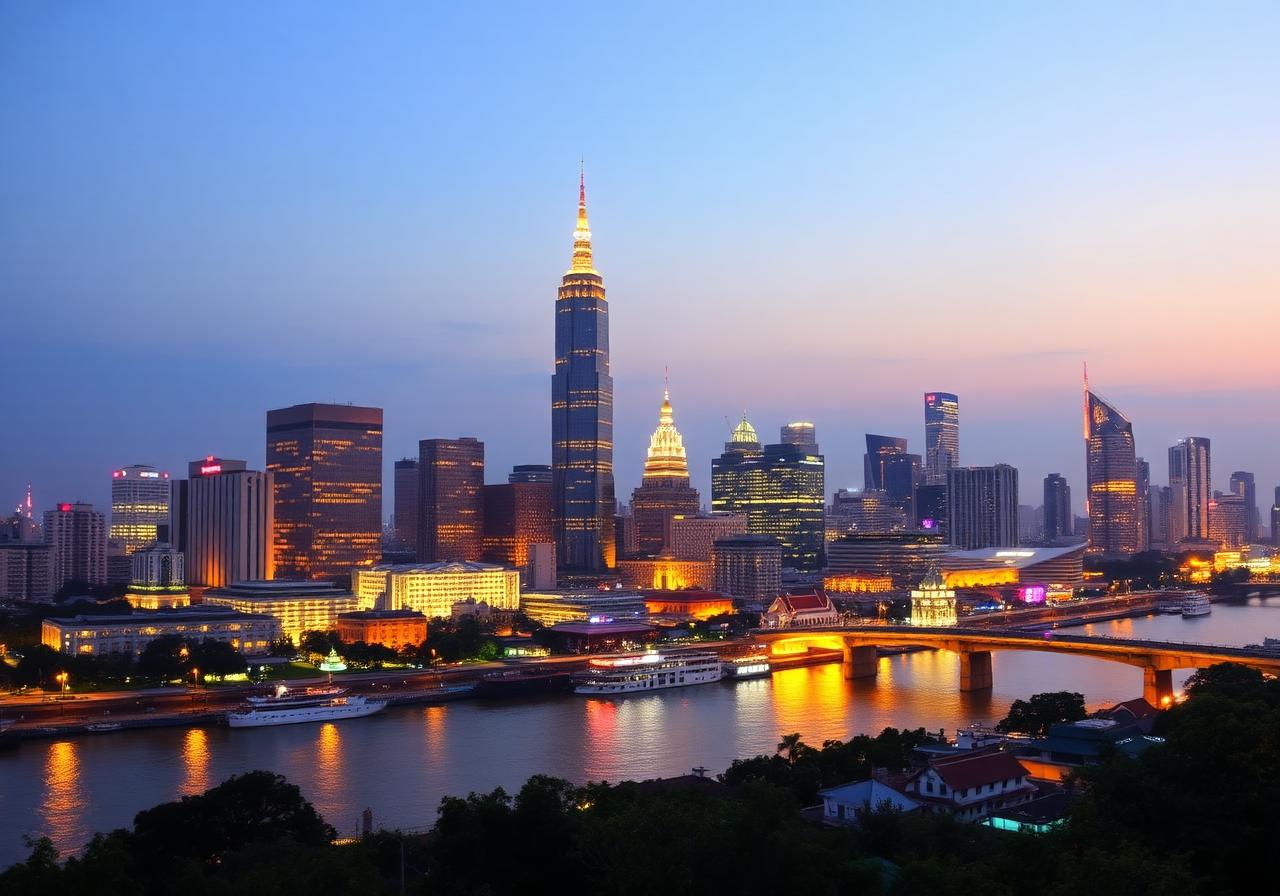

Bangkok · Intelligence Centre
Bangkok Intelligence
Centre.
Institutional research hub for investors evaluating Bangkok property. Comparative rankings across seven submarkets, transit-oriented investment thesis, foreign-freehold quota intelligence and regional capital-city context. In the language of Knight Frank, JLL, Savills and McKinsey, not the language of brochures.
01 The Bangkok Intelligence Centre Thesis
Why bangkok intelligence centre merits institutional attention.
- 01
Transit Anchors Value
Proximity to BTS / MRT stations is the single most reliable predictor of long-run rental demand and resale liquidity in Bangkok.
- 02
Capital Preservation First
Prime CBD scarcity districts deliver defensive capital preservation. Bangkok is not a yield substitute for Phuket or Pattaya.
- 03
Foreign Quota Discipline
49% per-building foreign-freehold quota is tight in true-prime towers. Verify per project before commitment.
- 04
Comparative Framework
Bangkok is seven distinct submarkets. Underwrite them comparatively, not individually. Every grade carries a written rationale.
Bangkok Intelligence Centre · Market Signals
Each with written grade rationale.
Prime CBD condominium band.
Per-building, verify per project.
Walking-distance transit dominates resale.
01 · Executive Summary
What this Intelligence Centre concludes.
Bangkok is Thailand's deepest foreign-freehold condominium market and the most defensive urban allocation across the Core Investments coverage universe. Its investment case rests on four structural factors: BTS / MRT transit-anchored value, prime CBD scarcity in a small number of submarkets, deep international corporate and expatriate tenant base, and the 49% per-building foreign-freehold framework that delivers institutional-grade resale liquidity for the inventory that sits inside it.
The investor question is no longer "is Bangkok investable". The investor question is "which Bangkok submarket fits this objective, at which transit anchor, and against which foreign-quota constraint?" This Intelligence Centre answers that question at the area level, with comparative rankings across seven submarkets and underwriting discipline designed to a Knight Frank / JLL / Savills institutional standard.
The Centre is the canonical Bangkok reference for the platform. It supersedes the legacy Bangkok Property Investment Outlook page, which now redirects here.
02 · Bangkok Submarket Rankings
Seven submarkets, ranked comparatively.
Relative rankings across the seven Bangkok submarkets only. Not absolute return forecasts. Each row carries a grade rationale. Project-level outcomes within a submarket can diverge materially from the submarket grade; underwriting must descend to project, operator and contract level.
| # | Submarket | Overall | Rental | Growth | Risk | Confidence |
|---|---|---|---|---|---|---|
| 01 | Thonglor The institutional core of Bangkok lifestyle prime. Best fit for capital-preservation buyers and expat-targeted long-let landlords prioritising tenant depth and resale liquidity. | A | A | A- | Low-Moderate | High |
| 02 | Phrom Phong Family-segment prime. Best fit for end-user families, long-let landlords targeting international-school catchments and capital-preservation buyers. | A | A | A- | Low-Moderate | High |
| 03 | Asoke Transit-anchored yield core. Best fit for yield-focused investors prioritising rental velocity and resale liquidity over scarcity-led capital growth. | A- | A | B+ | Low-Moderate | High |
| 04 | Sathorn CBD finance corridor. Best fit for corporate long-let landlords, capital-preservation buyers and investors prioritising defensive CBD exposure. | A- | A- | B+ | Low-Moderate | High |
| 05 | Riverside Trophy waterfront tier. Best fit for capital-preservation HNW buyers and branded-residence investors with longer holding periods. | B+ | B | A- | Moderate | Medium |
| 06 | Ari Emerging gentrification node. Best fit for medium-term capital-growth investors and yield buyers seeking sub-central Sukhumvit entry tickets. | B+ | B+ | B+ | Moderate | Medium |
| 07 | Rama 9 New CBD thesis allocation. Best fit for medium-term capital-growth investors comfortable with masterplan-dependent thesis; not for yield-now mandates. | B | B | B+ | Moderate | Medium |
03 · Submarket Intelligence
Open the dedicated page for each Bangkok submarket.
Each submarket page carries an executive summary, transit and rental analysis, foreign-quota intelligence, supply and risk assessment, and a project-intelligence placeholder for the future /bangkok/{submarket}/projects/{slug} layer.
Rank 01
AThonglor
The institutional core of Bangkok lifestyle prime. Best fit for capital-preservation buyers and expat-targeted long-let landlords prioritising tenant depth and resale liquidity.
Read intelligence
Rank 02
APhrom Phong
Family-segment prime. Best fit for end-user families, long-let landlords targeting international-school catchments and capital-preservation buyers.
Read intelligence
Rank 03
A-Asoke
Transit-anchored yield core. Best fit for yield-focused investors prioritising rental velocity and resale liquidity over scarcity-led capital growth.
Read intelligence
Rank 04
A-Sathorn
CBD finance corridor. Best fit for corporate long-let landlords, capital-preservation buyers and investors prioritising defensive CBD exposure.
Read intelligence
Rank 05
B+Riverside
Trophy waterfront tier. Best fit for capital-preservation HNW buyers and branded-residence investors with longer holding periods.
Read intelligence
Rank 06
B+Ari
Emerging gentrification node. Best fit for medium-term capital-growth investors and yield buyers seeking sub-central Sukhumvit entry tickets.
Read intelligence
Rank 07
BRama 9
New CBD thesis allocation. Best fit for medium-term capital-growth investors comfortable with masterplan-dependent thesis; not for yield-now mandates.
Read intelligence
04 · Transit-Oriented Investment Thesis
Why BTS and MRT proximity decides outcomes.
Bangkok traffic friction makes walking-distance access to BTS or MRT stations a material price driver. Tenants pay a measurable premium for transit-adjacent inventory; resale buyers price the same premium into exit comparables. The premium compounds over the hold. Non-transit-adjacent inventory in otherwise identical submarkets typically trades and rents at a discount that widens over time.
The Bangkok mass-transit network operated by the Mass Rapid Transit Authority of Thailand (MRTA) currently spans the BTS Sukhumvit and Silom lines, the MRT Blue Line, a 48-kilometre, 38-station closed-loop line operated by Bangkok Expressway and Metro (FACT, BEM / MRTA, 2024), the MRT Purple Line (Chalong Ratchadham), the MRT Yellow Line (Nakkhara Phiphat) and the MRT Pink Line (Wiwat Nakhon); the Orange Line is under construction and the SRT Red Line operates from Bang Sue Grand Station as the principal long-distance and suburban rail hub (FACT, MRTA, SRT, Ministry of Transport). Bangkok is served by two international airports, Suvarnabhumi (BKK) and Don Mueang (DMK), both operated by Airports of Thailand (AOT). Suvarnabhumi handled 62.2 million passengers in calendar year 2024 (FACT, AOT traffic disclosure, January 2025).
The seven Centre submarkets are organised around six transit anchors: BTS Sukhumvit (Thonglor, Phrom Phong, Asoke, Ari), BTS Silom and MRT Blue Line (Sathorn), MRT Blue Line interchange (Rama 9) and the Chao Phraya river corridor (Riverside, where transit access is the structural weakness offset by waterfront scarcity).
05 · Foreign Quota & Supply Intelligence
How the 49% framework shapes Bangkok underwriting.
Thai condominium law (Condominium Act B.E. 2522, as amended) caps foreign-freehold ownership at 49% of saleable area per building (FACT, statutory). The Real Estate Information Center (REIC) publishes quarterly foreign-condominium-transfer data at national level. According to REIC, Chinese nationals accounted for 2,872 condominium-ownership transfers to foreigners in H1 2024, 39.5% of all foreign condo transfers nationwide in that period (FACT, REIC, H1 2024). For full-year 2024, REIC reports that foreign condominium-transfer units rose 0.86% year-on-year while transfer value declined 6.8% year-on-year (FACT, REIC, 2024 full year). In true-prime Bangkok towers (Thonglor frontage, Phrom Phong family-segment prime, Sathorn finance prime, Riverside trophy) the foreign quota is structurally tight; availability must be verified per project before commitment.
Primary-market (off-plan) and secondary-market (resale) inventory carry different quota dynamics. Primary inventory is sold against the developer's reserved foreign quota; secondary inventory transacts against the building's residual quota at the time of registration. Both pathways require project-level confirmation; submarket-level signal is directional only.
06 · Regional Capital Comparison
Bangkok versus Singapore, Hong Kong, Kuala Lumpur.
Bangkok prime CBD condominium pricing sits structurally below Singapore and Hong Kong prime by a material margin, and above Kuala Lumpur prime. The gap to Singapore and Hong Kong reflects market depth, currency strength and capital-account openness; the gap above Kuala Lumpur reflects tourism, corporate occupier depth and the foreign-freehold framework. Bangkok's defensive case for regional Asian capital is anchored in this position: institutional-grade urban exposure at materially lower per-sqm pricing than Singapore or Hong Kong, with foreign-freehold accessibility that Kuala Lumpur does not match for international capital.
Comparison is directional. Per-sqm benchmarks across the four cities are sourced from Knight Frank Prime International Residential Index, CBRE and Savills regional reports; underwriting requires a current cross-city pull at the time of allocation.
07 · Yield vs Growth Outlook
Capital preservation, not high-yield income.
Gross indicative yield for prime Bangkok condominiums sits in a 4–6% band, with selective managed product reaching ~7%. This is materially below resort-market yield expectations. Bangkok's total return is anchored in capital preservation and currency-diversification, not in income.
Supply discipline is improving: CBRE Thailand reported just 2,132 condominium units launched in Bangkok in Q3 2024, a 69.7% quarter-on-quarter and 71.7% year-on-year decline (FACT, CBRE Bangkok Overall Figures, Q3 2024). JLL reports Bangkok residential total stock reaching ~75,900 units by end-2024 with 2,800 new units across 12 projects and an average pre-sales rate of 68% (FACT, JLL Bangkok Residential, end-2024). At the luxury tier, CBRE Thailand reports that foreigners, predominantly Chinese and Taiwanese, accounted for 33% of CBRE-sold luxury condominium units in H1 2024 (up from 25% in H1 2023), with luxury asking prices reported around 350,000 THB/sqm (FACT, CBRE Thailand, H1 2024). On the commercial side, CBRE recorded Bangkok office occupancy at 81.8% in Q3 2024 (FACT, CBRE, Q3 2024); JLL reports Bangkok total office stock at approximately 1.8 million sqm by end-2024 with a market-wide vacancy rate around 29% reflecting recent supply completions (FACT, JLL Bangkok Office Market, 2024). JLL also records 2024 prime office net absorption of 19,500 sqm and full-year market absorption of 107,200 sqm, the strongest five-year level (FACT, JLL Bangkok Office, full-year 2024). Colliers Thailand cautions that Bangkok office supply is set to grow by approximately 1.1 million sqm over the three years following Q4 2024, signalling continued oversupply pressure on Grade-A rents (FACT, Colliers Thailand, Q4 2024).
Investors applying resort-style yield expectations to Sathorn or Thonglor underwrite the city incorrectly. The honest framing is that Bangkok diversifies a Thailand portfolio away from pure resort cyclicality, and it should be evaluated against that mandate.
08 · Investor Suitability
Which Bangkok submarket fits which mandate.
- Capital Preservation (International, 7–10y). Thonglor or Phrom Phong first, then Sathorn. Prime expatriate corridors with deepest tenant pool and resale velocity.
- Yield-Focused (Transit-Anchored). Asoke first, then Sathorn. Highest rental velocity in the Sukhumvit corridor; balanced corporate and lifestyle long-let demand.
- Family / End-User. Phrom Phong first. Anchored by EmDistrict retail, international-school catchment and Japanese-expat ecosystem.
- Trophy / Ultra-Prime HNW. Riverside. Waterfront branded-residence pipeline (Four Seasons, Mandarin Oriental, Capella). Longer holding period; trophy-tier resale.
- Medium-Term Capital Growth. Ari for gentrification trajectory; Rama 9 for new-CBD masterplan thesis. Both scenario-dependent; not yield-now mandates.
- Not Suited to Bangkok. Investors targeting resort-style 7–9% gross yields, or short-horizon flips, should benchmark Phuket and Pattaya before allocating to Bangkok.
09 · Risk Analysis
The risks that matter to Bangkok underwriting.
- Mass-Market Oversupply. Mass-market suburban condominium corridors have absorbed multiple cycles of new supply. Submarket selection is the dominant risk-control.
- Corporate Mobility Cycle. Sathorn, Asoke and Phrom Phong long-let demand is exposed to regional HQ footprint decisions and hybrid-work patterns.
- Foreign-Quota Pressure. True-prime towers carry tight foreign-freehold quota; commitments without project-level verification carry execution risk.
- Transit-Access Gap. Riverside trophy product is structurally weaker on BTS / MRT access; the weakness is offset by waterfront scarcity but does not disappear.
- Masterplan Execution. Rama 9 capital-growth thesis depends on continued maturation of the Grand Rama 9 / G Land office-and-retail cluster.
- FX Risk. THB volatility against USD, EUR, GBP can move investor-realised returns by 10–20% across a typical holding period.
10 · Methodology & Sources
How the rankings are built, and how they should be read.
Submarkets are scored across five institutional vectors: rental-economics depth, capital-growth structural support, supply and pipeline risk, operator-bench depth, and resale liquidity. Each vector is weighted by evidence strength, not by narrative weight. Output is a relative ranking across the seven Bangkok submarkets only.
Evidence hierarchy: Tier 1 published government / regulator data (Bank of Thailand, NESDC, BOI, REIC, BMA, MRTA, SRT, Ministry of Transport, AOT, IMF, World Bank, OECD); Tier 2 institutional broker and macro research (CBRE, Knight Frank, Colliers, Savills, JLL, EIU); Tier 3 developer disclosures; Tier 4 field observation. Lower-tier inputs cannot override higher-tier inputs.
The Centre links into the country layer at Thailand Property Market Intelligence and operates alongside the Phuket, Pattaya and Macro centres.
Investor Questions
Bangkok Intelligence Centre, frequently asked questions.
- Q01
- What is the Bangkok Intelligence Centre?
- It is the central institutional research hub for investors comparing Bangkok submarkets. It consolidates rankings, transit-oriented investment thesis, foreign-freehold quota intelligence and regional capital comparison across seven Bangkok submarkets in one reference page.
- Q02
- Which Bangkok submarkets does the Centre rank?
- Seven institutional submarkets: Thonglor, Phrom Phong, Asoke, Sathorn, Riverside, Ari and Rama 9. Thonglor incorporates Ekkamai context; Sathorn incorporates Silom context. Sukhumvit is treated as a corridor, not a submarket. Bang Sue, Ratchaprasong, Wireless Road and Phaya Thai are future-coverage candidates.
- Q03
- Is Bangkok a yield play or a capital-preservation play?
- Both, but the dominant thesis is capital preservation in prime CBD scarcity districts. Gross indicative yields for prime Bangkok condominiums sit in a 4–6% band; total return is anchored more in capital preservation than in income. Bangkok diversifies a Thailand portfolio away from pure resort cyclicality but is not a substitute for resort exposure.
- Q04
- How is the foreign-freehold quota tracked?
- Foreign-freehold quota in prime Bangkok condominium buildings is governed by the 49% per-building cap under Thai condominium law. Quota availability in true-prime towers can be tight and must be verified per project before commitment. The Centre flags quota pressure at the submarket level and defers project-level confirmation to the acquisition stage.
- Q05
- Why does transit proximity dominate the analysis?
- Bangkok traffic friction is severe. Tenants and resale buyers pay a measurable premium for walking-distance access to BTS or MRT stations. The premium compounds over the hold; non-transit-adjacent inventory in otherwise identical submarkets typically trades and rents at a discount that widens over time.
- Q06
- How often is the Intelligence Centre updated?
- Rankings and outlook are reviewed on a rolling basis as published data is released by CBRE, Knight Frank, Colliers, JLL, Savills, the Bank of Thailand and the World Bank. Material revisions update the dateModified stamp on the page header.
Share this research
Direct Access
Speak with Frank about bangkok intelligence centre.
Request a confidential Bangkok-specific briefing covering submarket selection, foreign-quota verification, transit-anchor pricing and acquisition strategy across the seven Centre submarkets.
- Frank Satar
- Chief Founder & Research Director
- Australia
- +61 494 651 747
- Thailand / WhatsApp
- +66 65 551 3269
Sources & References
Where this research draws its data.
Core Investments cites only published institutional sources. Figures referenced on this page are drawn from, or cross-checked against, the institutions listed below. For our editorial standards and source-vetting process, see our research methodology.
- [1]
- [2]
Knight Frank Thailand
Bangkok Condominium Market Report & Thailand Residential Research · 2024
https://www.knightfrank.co.th/research → - [3]
Colliers
Thailand Market Snapshot. Residential & Hospitality · 2024
https://www.colliers.com/en-th/research → - [4]
Savills
Asia Pacific Investment Quarterly & Thailand Spotlight · 2024
https://www.savills.com/research/ → - [5]
JLL Hotels & Hospitality
Hotel Investment Outlook. Asia Pacific (Annual) · 2024
https://www.jll.com/en/insights/research → - [6]
Knight Frank
The Wealth Report (Branded Residences & Prime International Residential Index) · 2024
https://www.knightfrank.com/wealthreport → - [7]
Bank of Thailand
Monetary Policy Report · 2024
https://www.bot.or.th/en/our-roles/monetary-policy/MPC-publication.html → - [8]
- [9]
Real Estate Information Center (REIC), Government Housing Bank
Thailand Housing Market Reports. Transfers, Supply & Foreign Condominium Transfers · 2024
https://www.reic.or.th/ → - [10]
Bangkok Metropolitan Administration (BMA)
Bangkok Statistical Profile & Registered Population · 2024
https://www.bangkok.go.th/ → - [11]
Mass Rapid Transit Authority of Thailand (MRTA)
MRT Network Map & Line Status (Blue, Purple, Orange, Pink, Yellow) · 2024
https://www.mrta.co.th/en/ → - [12]
State Railway of Thailand (SRT)
SRT Red Line & Bang Sue Grand Station Operations · 2024
https://www.railway.co.th/ → - [13]
Ministry of Transport, Thailand
Thailand Transport Infrastructure Plans & Mass Transit Master Plan · 2024
https://www.mot.go.th/en/home → - [14]
Airports of Thailand (AOT)
Suvarnabhumi (BKK) & Don Mueang (DMK) Air Traffic Reports · 2024
https://corporate.airportthai.co.th/en/air-transport-statistic/ → - [15]
Economist Intelligence Unit (EIU)
Thailand Country Report & Worldwide Cost of Living (Bangkok) · 2024
https://www.eiu.com/n/country/thailand/ → - [16]
Office of the National Economic and Social Development Council (NESDC)
Thailand Quarterly Gross Domestic Product & Economic Outlook · 2024
https://www.nesdc.go.th/nesdb_en/ → - [17]
- [18]
International Monetary Fund (IMF)
World Economic Outlook · 2024
https://www.imf.org/en/Publications/WEO → - [19]
National Statistical Office (NSO), Thailand
Statistical Yearbook Thailand. Population from Registration Record · 2024
https://www.nso.go.th/ → - [20]
Bangkok Expressway and Metro PCL (BEM)
MRT Blue Line & Purple Line System Map · 2024
https://metro.bemplc.co.th/MRT-System-Map?lang=en →
Sources last reviewed 2026-06-14
Disclosures
Important information.
Capital appreciation disclaimer
Capital appreciation examples and growth projections are illustrative only and should not be interpreted as predictions or guarantees of future performance. Property values may rise or fall and are influenced by market conditions, supply, demand, economic factors, regulatory changes and investor sentiment.
Rental return disclaimer
Rental income examples, occupancy assumptions and yield illustrations are provided for educational purposes only. Actual rental performance may vary based on market conditions, occupancy levels, operator performance, seasonality, competition, economic conditions and other factors. Rental returns are not guaranteed unless expressly stated within a legally binding agreement.
Forecast disclaimer
Forecasts, projections and forward-looking statements are based on information available at the time of publication and involve assumptions that may not materialise. Future events may differ significantly from projected outcomes.
General disclaimer
Core Investments provides investment education, market intelligence, research and transaction-support services. Information published on this website is general in nature and does not constitute financial, investment, legal, tax or accounting advice, or personal recommendations. Investors should seek independent professional advice appropriate to their individual circumstances before making any investment decision. Past performance is not indicative of future results.
© Core Investments Research | Frank Satar
Research produced by Core Investments. Reproduction or redistribution without written permission is prohibited.